Prepared by: @ravinojonalyn397
"Learning is not ending"
"Family life is the source of the greatest human happiness."
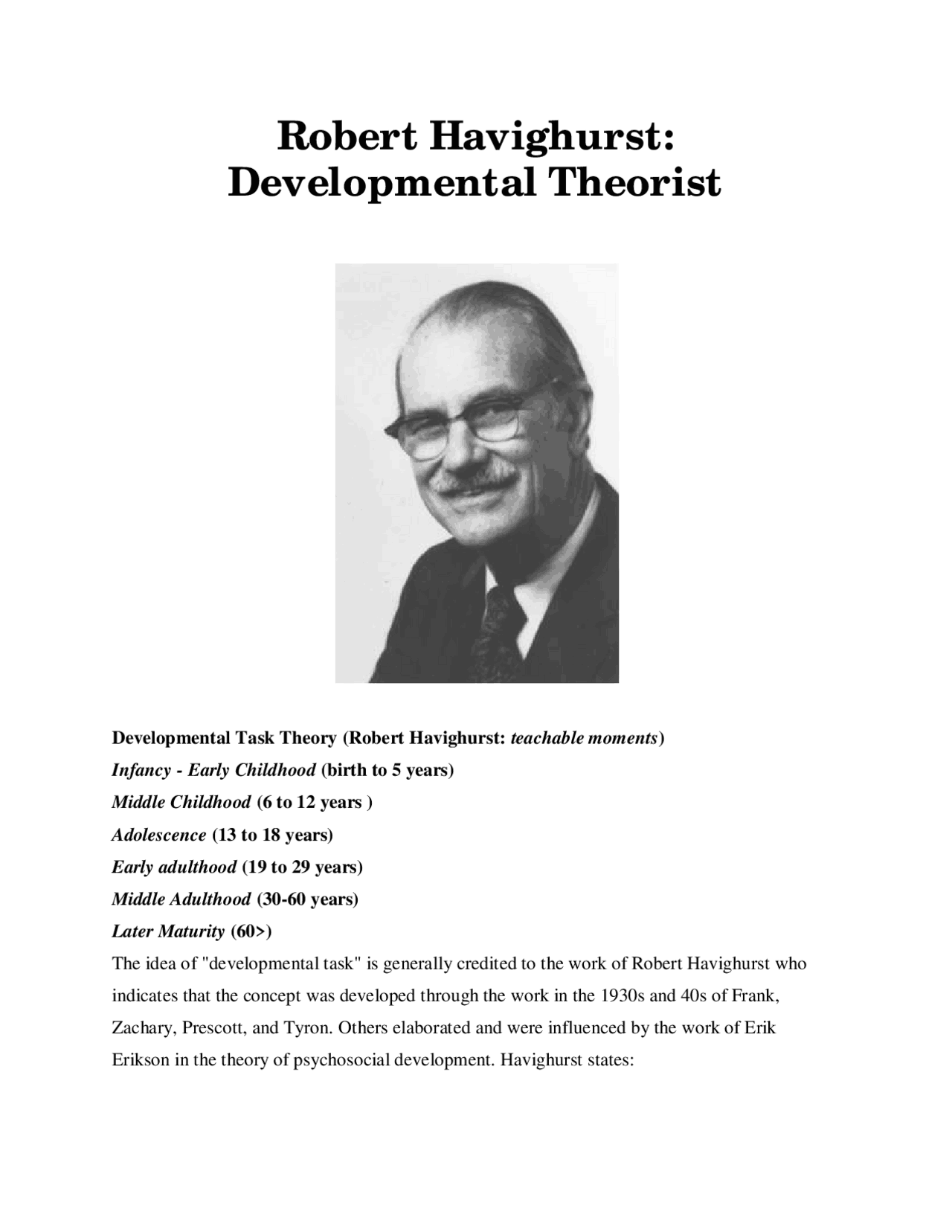
Robert James Havighurst (Hurlock).
(June 5, 1900 – January 31, 1991) was a chemist and physicist, educator, and expert on human development and aging. Havighurst worked and published well into his 80s. He died of Alzheimer’s disease in January 1991 in Richmond, Indiana at the age of 90
He published a number of papers in journal of physics and chemistry about the structure of the atom in 1924. He went to Harvard University as a postdoctoral fellow, studying atomic structure and publishing papers in journals of physics and chemistry.
He decided to change careers in 1928, so he went into the field of experimental education. He became an assistant professor at the University of Wisconsin–Madison. In 1940, he became an education professor at the University of Chicago in the University’s Committee on Human Development. He worked in the field of aging. Again, in the same year he was interested in international and comparative aspects of education. He wrote several books and published many papers. His best-known book called “Human Development and Education”. He was named a member of the National Academy of Education in 1965. He retired in 1983

Havighurst’s Developmental Task Theory
Havighurst identified six major stages in human life covering birth to old age:
- Infancy & early childhood (Birth till 6 years old)
- Middle childhood (6–12 years old)
- Adolescence (13–18 years old)
- Early Adulthood (19–30 years old)
- Middle Age (30–60 years old)
- Later maturity (60 years old and over)
From there, Havighurst recognized that each human has three sources for developmental tasks. They are:
- Tasks that arise from physical
- maturation: Learning to walk, talk, control of bowel and urine, behaving in an acceptable manner to opposite sex, adjusting to menopause.
- Tasks that arise from personal values: Choosing an occupation, figuring out one’s philosophical outlook.
- Tasks that have their source in the pressures of society: Learning to read, learning to be a responsible citizen.
The developmental tasks model that Havighurst developed was age dependent and all served pragmatic functions depending on their age.
Robert J. Havighurst Selected works

- Warner, Lloyd W.; Havighurst, Robert J.; and Davis, Allison. Who Shall Be Educated? The Challenge of Unequal Opportunities. New York: Harper, 1944.
- Havighurst, Robert J.; and Neugarten, Bernice L. Father of the Man: How Your Child Gets His Personality. New York: Houghton, 1947.
- Havighurst, Robert J.; Stivers, Eugene; and Dehaan, Robert F. American Indian and White Children: A Sociopsychological Investigation. Chicago: University of Chicago Press, 1955.
- Gross, Irma; Havighurst, Robert J.; et al. (Eds.) A Survey of the Education of Gifted Children. Chicago: University of Chicago Press, 1955.
- Havighurst, Robert J.; and Dehann, Robert F. Potentialities of Women in the Middle Years. East Lansing: Michigan State University Press, 1957.
- Havighurst, Robert J.; et al. Educating Gifted Children. Chicago: University of Chicago Press, 1957.
- Havighurst, Robert J.; Neugarten, Bernice L.; and Falk, Jacqueline M. Growing up in River City. New York: Wiley, 1962.
- Havighurst, Robert J., (Ed.). Society and Education: A Book of Readings. New York: Allyn & Bacon, 1967.
- Havighurst, Robert J.; et al. Comparative Perspectives on Education. New York: Little, Brown, 1968.
- Havighurst, Robert J. Adjustment to Retirement: A Cross-national Study. Van Gorcum, 1969.
- Havighurst, Robert J. Developmental Tasks and Education. McKay, 1972.
- Havighurst, Robert J. To Live on this Earth: American Indian Education. New York: Doubleday, 1972.

 Foundation of Education